At 52, I Stopped Accepting That Feeling Worn Down Was Just Part of Getting Older
A former weekend athlete on the small, research-backed routine that changed how she starts and ends her days, and why it was the first thing she actually stuck with.
I want to start with something honest: I am not a health writer, and I am not here to sell you a miracle. I'm a mom of two, I work a desk job, and for most of my forties I told myself that feeling a little more worn down every year was simply what getting older looked like.
Mornings were the worst part. I'd get out of bed stiff, shuffle to the coffee maker, and need a good twenty minutes before I felt like a person. By three in the afternoon I was flat. By nine at night I was too tired to do anything but scroll, and somehow still not tired enough to sleep well.
I used to run half marathons in my thirties. I used to garden every weekend. Somewhere along the way, without any single dramatic moment, I just stopped.
Everything I tried first
If you're reading this, you've probably tried some version of my list. I bought a gym membership I used for six weeks. I downloaded three different sleep apps. I tried cutting caffeine, then tried more caffeine. I spent an embarrassing amount on supplements that promised everything on the label and delivered a lighter wallet.
None of it was wrong, exactly. Walking more helped. Eating better helped. But I kept hitting the same wall: I'd start strong, life would get busy, and the routine would quietly fall apart.
What I needed wasn't more willpower. It was something small enough to fit into the life I actually had.
“I didn't need a new personality. I needed something that took less than a minute and didn't fall apart the first busy week.”
[Writer name]
The conversation that started it
It was a friend of mine who coaches strength athletes who first mentioned peptides. We were catching up over coffee and I was complaining, as usual, about how stiff I felt on my morning walks.
She told me that a lot of the athletes she works with had been reading about specific peptides, and that the research behind them was more interesting than I'd expect. I went home and spent the next two weeks reading everything I could find.
So what actually are peptides?
Peptides are short chains of amino acids, the same building blocks that make up proteins. Your body already makes thousands of them, and they act as signalling molecules, a bit like messages that tell cells what to do.
Researchers study specific peptides to understand how the body maintains and renews its own tissues. A few names come up again and again:
The names you'll see most
- BPC-157: studied for its role in tissue signalling and repair pathways
- TB-500: a fragment of a naturally occurring protein, often studied alongside BPC-157
- GHK-Cu: a copper peptide widely studied in skin and collagen research
- NAD+: a molecule involved in cellular energy, studied in the context of ageing
I want to be careful here, because this is exactly where a lot of articles go off the rails. Research is research. It explores possibilities; it doesn't make promises about what will happen to you or me. What it did for me was make me curious enough to look for a way to try it responsibly.
The part that almost stopped me
Here's the thing nobody tells you: most of what I found involved injections. Vials, syringes, mixing powders with water, keeping everything in the fridge. I'm sure that works for some people. I knew instantly it was never going to work for me.
I can barely remember to take a vitamin. There was zero chance I'd be measuring out doses before school drop-off.
So I almost gave up. Then my friend sent me a photo of a small white box.
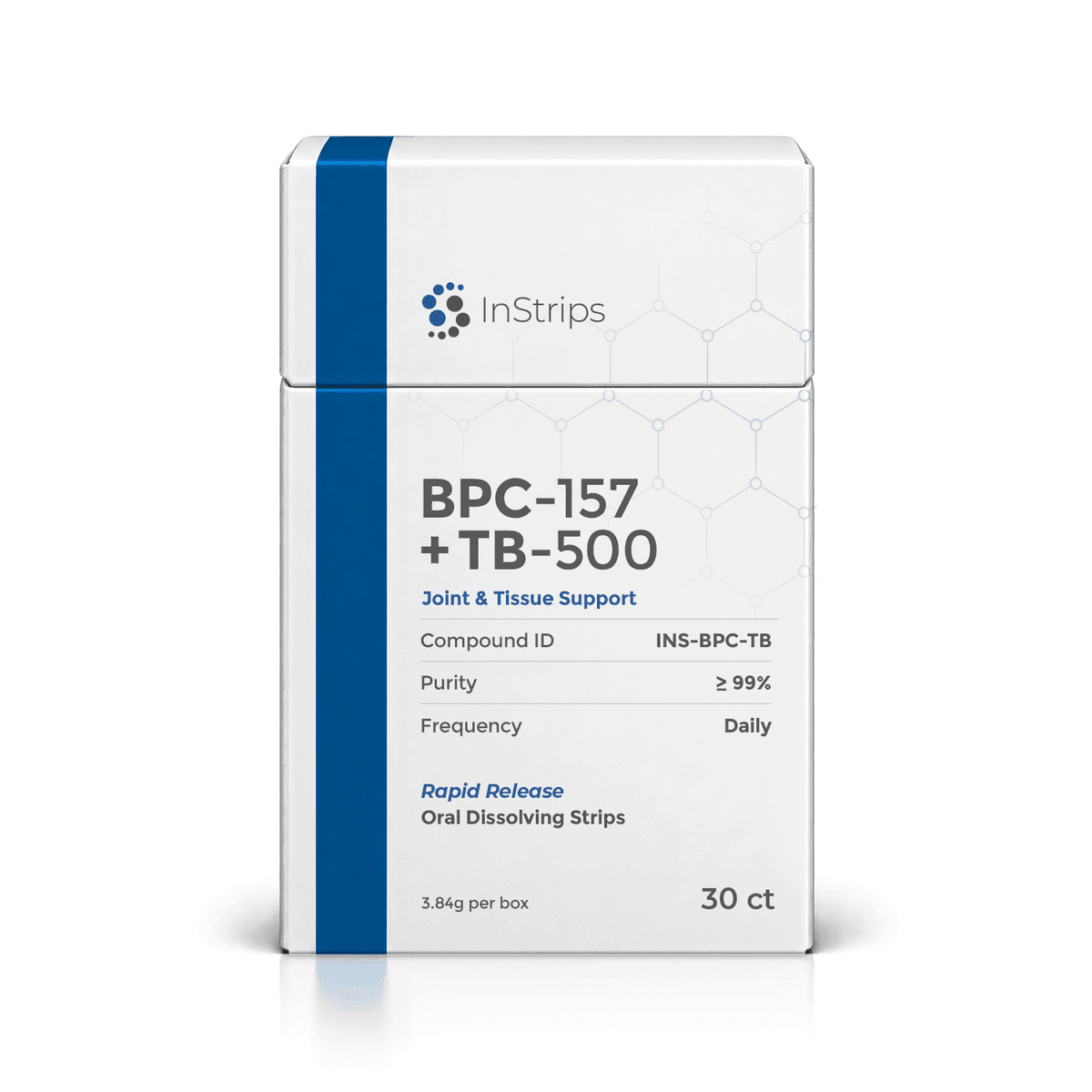
A strip instead of a needle
The box held thirty thin strips, each in its own foil packet. No mixing, no fridge, no needles. You place a strip on your tongue and let it dissolve against the roof of your mouth or the inside of your cheek. It takes about a minute.
That was it. That was the whole routine.
I'm a label reader, so before I tried anything I went through the details carefully. Each strip had a precise, measured dose printed right on the foil. Every lot came with a certificate of analysis from a third-party lab. They're made here in the USA. None of that guarantees anything about how you'll feel, but it told me the company took the basics seriously.
What I checked before I bought anything
- A specific dose per strip, printed on the foil, not a vague "blend"
- A certificate of analysis for every lot, from an independent lab
- Made in the USA, with an address on the box
- Individually sealed strips I could throw in my bag
- No needles, no mixing, no refrigeration
My first week
I decided to keep it simple: one strip in the evening, after dinner, while I cleaned up the kitchen. I set a reminder on my phone for the first few days, and after that it was just part of the routine, like brushing my teeth.
Honestly? Week one felt like nothing. I wasn't expecting fireworks and I didn't get any. What I did notice was that, for the first time in a long time, I'd started something and hadn't skipped a day.
Weeks two and three
This is where I started paying attention. I'm careful not to overstate it, because I was also walking more and going to bed earlier, so I can't untangle exactly what did what.
But I noticed I was looking forward to my morning walk instead of dreading the first ten minutes of it. I noticed I didn't need the afternoon coffee quite as badly. I noticed I'd read three chapters of a book in the evening instead of falling asleep on the couch with my phone in my hand.
Small things. But small things are what a day is made of.
Month one, and what I added
By the end of the first box I was curious enough to look at the rest of the line. I added two more, slowly, one at a time, so I'd know how each one fit:
GHK-Cu, the copper peptide that comes up constantly in skin research, went into my evening routine alongside the first strip.
NAD+ became my morning one. I take it with my first glass of water, before the coffee. It's become the small ritual that tells my brain the day has started.
What actually changed
I'll only speak for myself, because that's all I can honestly do.
I'm back in the garden on Saturday mornings. I walk the dog the long way round. I cook dinner most nights instead of ordering in because I'm too tired to think. I said yes to a weekend hike with friends last month, which would have been a firm no a year ago.
Is that all because of a strip? Almost certainly not. It's the walks, the earlier nights, the better food. But the strips were the first piece that was easy enough to stick with, and sticking with one thing made it easier to stick with the rest.
“The strips weren't the whole answer. They were the first thing easy enough to keep doing, and that changed everything else.”
[Writer name]
What I'd tell a friend
If you asked me over coffee, here's what I'd say:
It isn't magic. Sleep, food and movement still do the heavy lifting. Anyone telling you a single product replaces those is selling something.
Start with one. Give it a full month before you decide anything, and add things one at a time so you know what fits.
Read the label. Look for a real dose per strip, lab testing for every lot, and a company with an address. If you can't find those, walk away.
Talk to a professional if you have health conditions or take medication. I did, and it was a five-minute conversation that gave me peace of mind.
Why the strip format worked for me
- Under a minute, no water needed
- No needles, no mixing, no fridge
- Individually sealed, easy to travel with
- A precise, printed dose on every strip
- Lab tested, with a certificate of analysis per lot
- Made in the USA
Curious about the routine I use?
The company behind the strips is offering readers of this article their full routine: BPC-157 + TB-500, GHK-Cu and NAD+. It ships in discreet packaging.

Questions readers ask me
How do the strips work?
Place one on your tongue and let it dissolve against the roof of your mouth or the side of your cheek. It takes about a minute. No water, no needles.
When do you take them?
I take BPC-157 + TB-500 and GHK-Cu in the evening, and NAD+ in the morning. Each box has suggested timing on it.
How long does a box last?
Most boxes hold 30 strips, a one-month supply at one per day.
How long before you noticed anything?
For me it was a few weeks, and it was subtle. Everyone is different, so I'd give it a full month before deciding.
Are they tested?
Every lot comes with a certificate of analysis from an independent lab.
Do I need to refrigerate them?
No. Keep them somewhere cool and dry, sealed until you use them.
Can I travel with them?
Yes. Each strip is individually foil-sealed, so I just keep a few in my bag.
Should I check with a doctor first?
If you have any health conditions, are pregnant or take medication, yes. It's always worth a quick conversation.
Start with the same routine
One strip at night, one in the morning, and a month to see how it fits your life.
P.S. If you take one thing from this: start small. The best routine is the one you'll still be doing next month.